
New Texas BME Collaboration Funded by Research Corporation for Science Advancement and Chan Zuckerberg Initiative
Sapun Parekh, assistant professor of biomedical engineering, along with Texas BME alum Carolyn Bayer, make up one of ten multidisciplinary research teams that have received a combined $1,150,000 in funding as part of the inaugural year of Scialog: Advancing BioImaging.
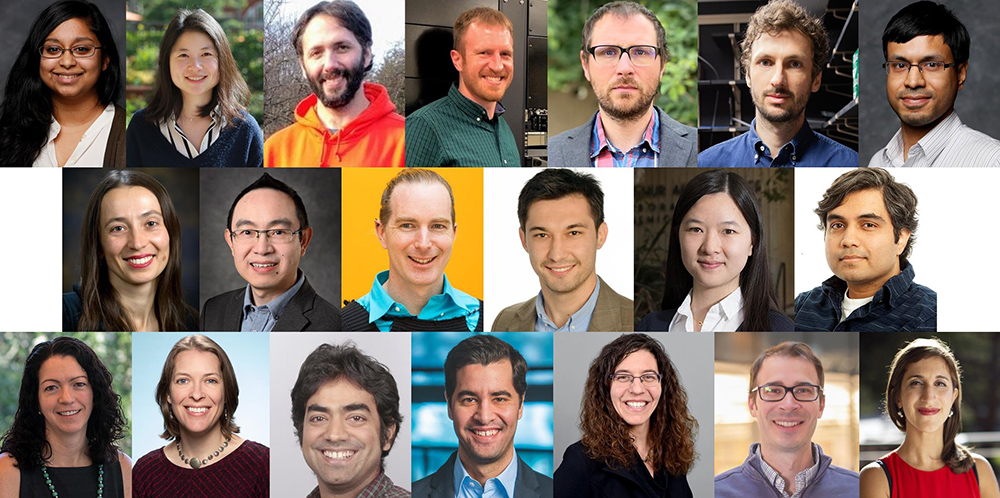
Scialog: Advanced Bioimaging is a three-year initiative supported by the Chan Zuckerberg Initiative, Research Corporation for Science Advancement, and Frederick Gardner Cotrell Foundation that aims to accelerate the development of the next generation of imaging technologies.
The Research Corporation for Science Advancement, the Chan Zuckerberg Initiative and the Frederick Gardner Cottrell Foundation awarded over $1 million to these researchers, who make up ten multidisciplinary teams.
One of the teams formed from Scialog, short for “science + dialogue,” includes co-investigators Sapun Parekh and Carolyn Bayer, an assistant professor of biomedical engineering at Tulane University, who completed her postdoctoral fellowship in biomedical engineering at UT Austin and received her Ph.D. in biomedical engineering under the mentorship of Nicholas Peppas. The team’s other co-investigator, Paris Perdikaris, is an assistant professor of mechanical engineering and applied mechanics at the University of Pennsylvania.
The three researchers are working on a project titled “Machine Learning to Identify Soft Tissue Molecular Signatures.”
The project entails studying pelvic organ prolapse, where a woman experiences a vaginal hernia and long-term pain. The condition affects up to one-third of women during their lifetimes, and surgical procedures fail 15 to 30% of the time due to mechanical incompatibilities and an insufficient understanding of the ever-changing soft tissue composition that predisposes a woman to the condition. The overall goals of the project will be to establish a multimodal imaging platform assisted by machine learning algorithms to analyze soft tissue molecular composition that will allow clinicians to identify women who can benefit from therapeutic interventions.
“Carolyn and I were a great match with our complementary expertise and joint interest in tissue molecular imaging,” says Sapun Parekh. “The fact that my lab inhabits her old postdoc lab space made for great conversation, and the project developed from there. After talking over our initial ideas for multi-modal imaging, we realized that Paris was critical to the team to fuse our datasets.”
Parekh will acquire hyperspectral coherent Raman and second harmonic generation images of collagen over millimeter fields of view with micrometer resolution from sectioned cervical tissue, while Bayer will perform 3D in vivo spectral photoacoustic imaging (sPA). Finally, Perdikaris will develop machine learning algorithms for multimodal image registration, aiming to predict the transformation by aligning sPA and coherent Raman images.