Our community has heart. And lungs. And a scalpel.
For students and faculty, outreach projects within BME are their own reward.
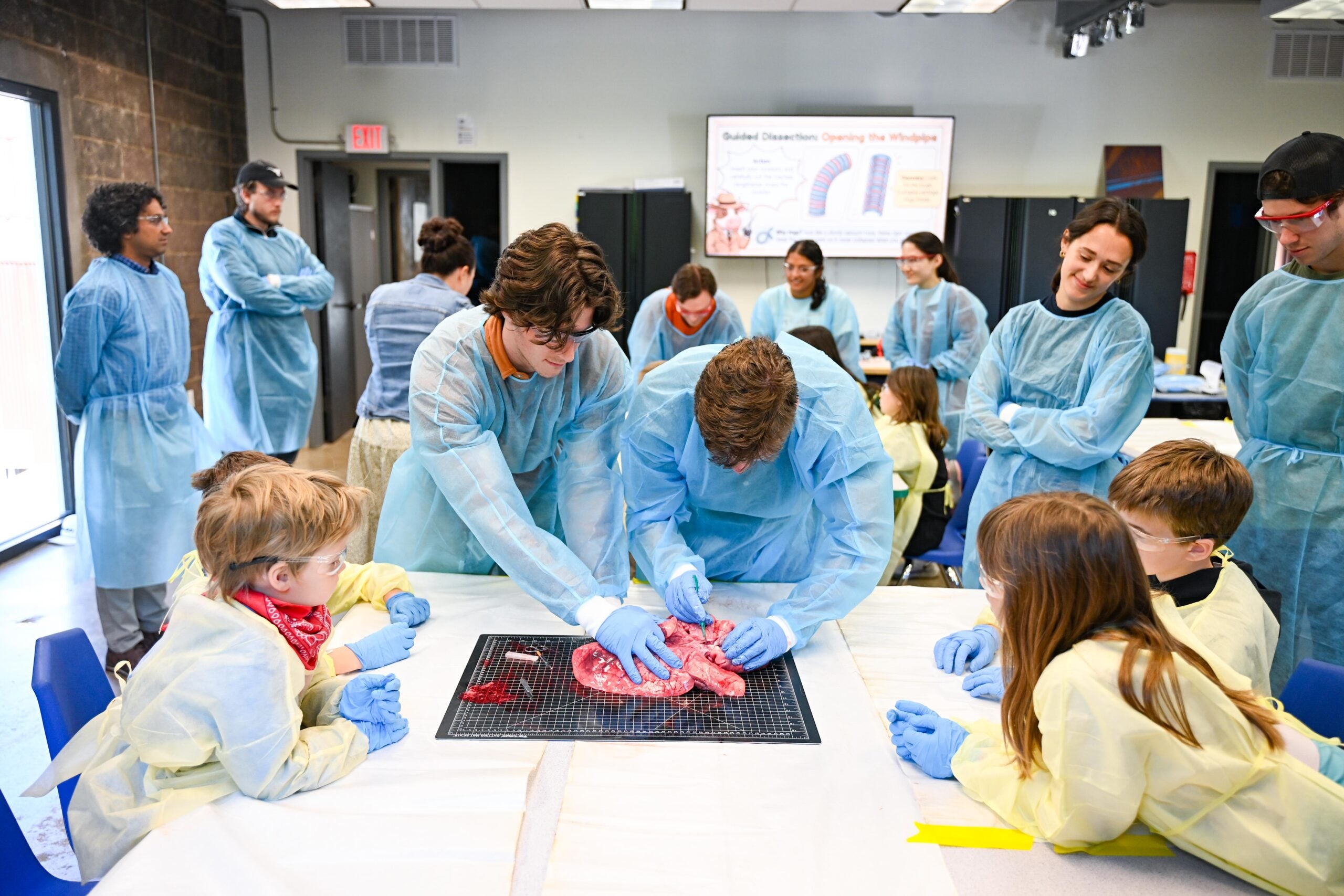
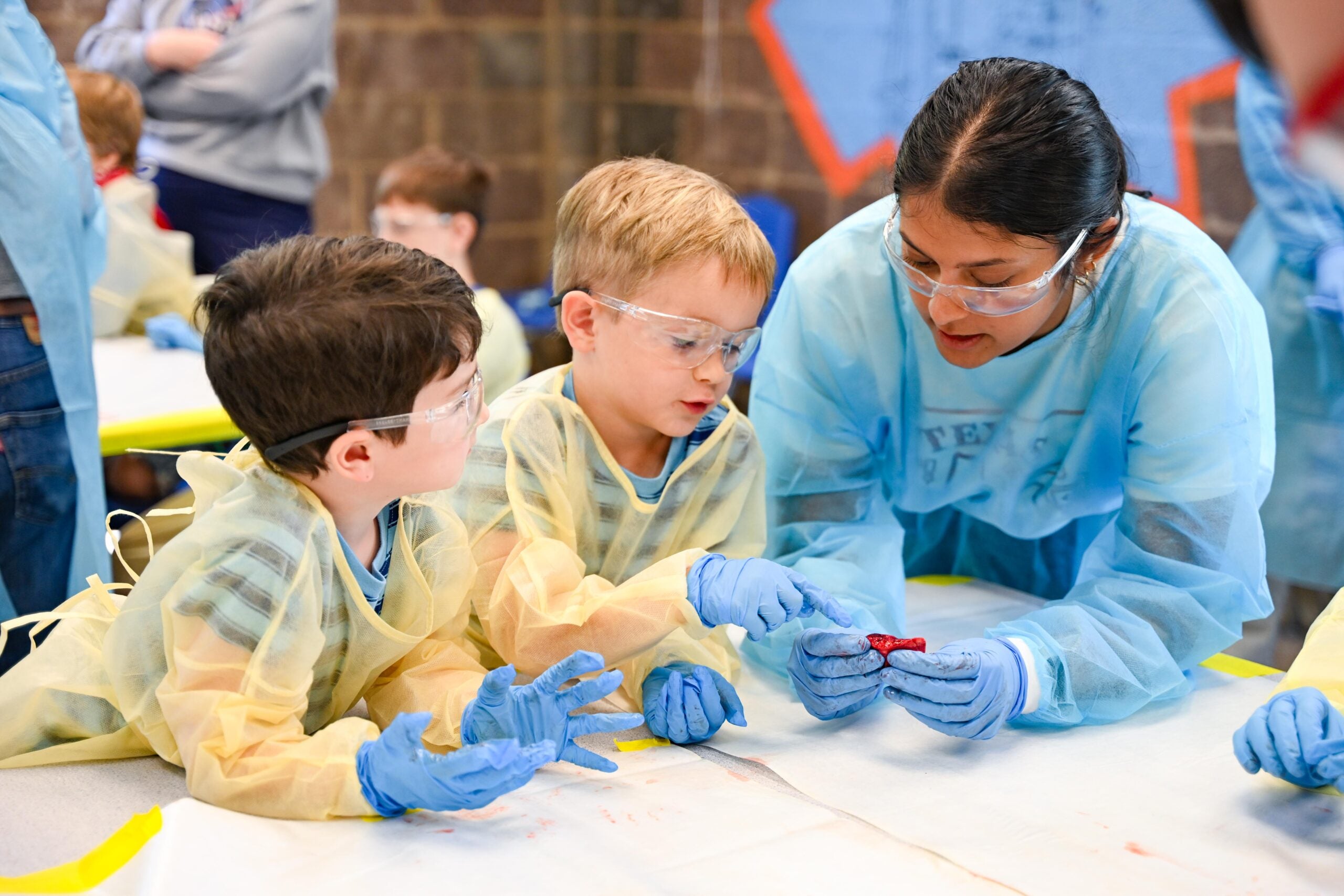
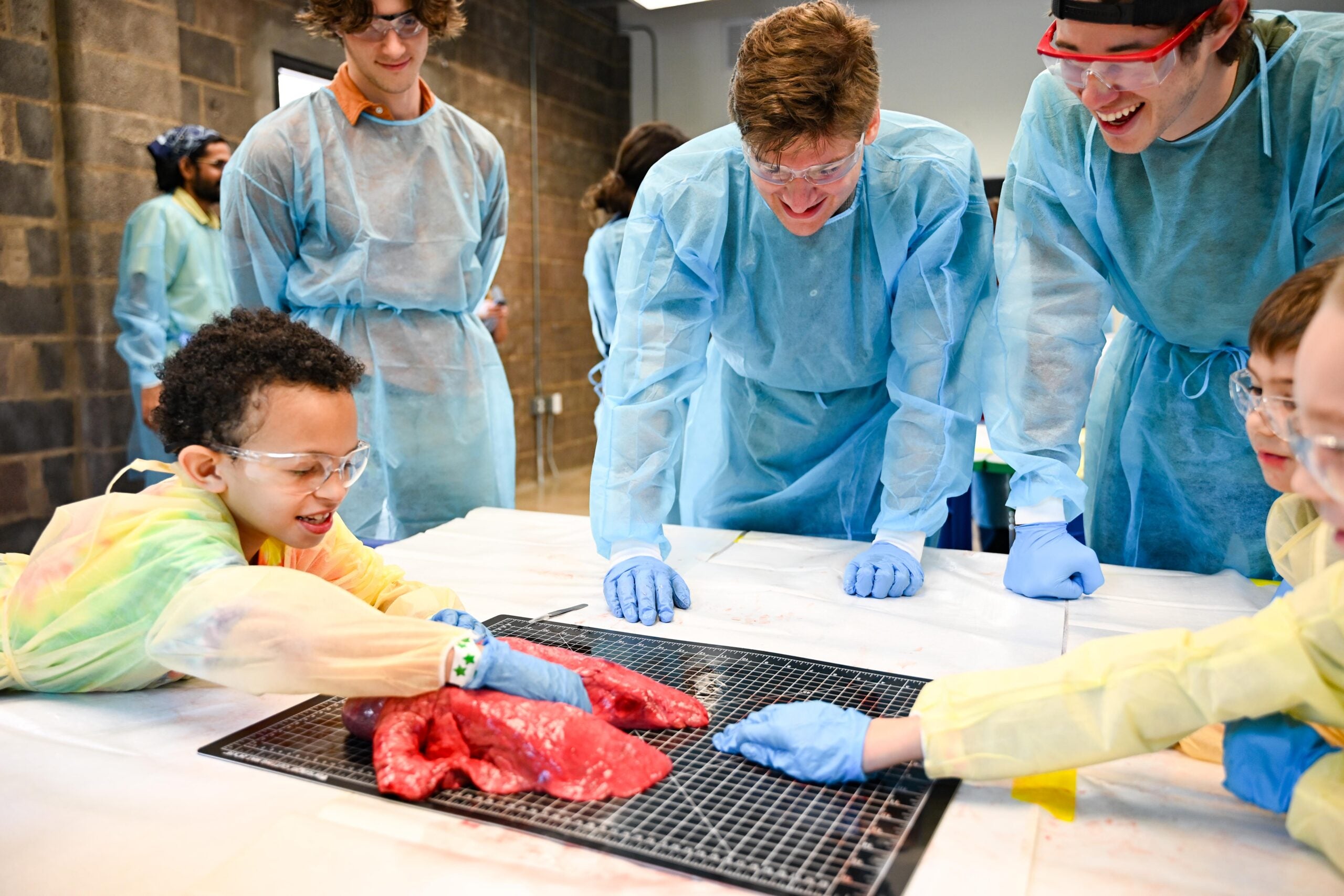
Oversized PPE gowns and gloves rustled as children ages five to 12 pressed around the dissection table. They argued, as kids do, about who got to stand where.
A parent called from the back of the classroom for a child to make room. “Be gentle. Be nice.”
This was a special treat, and everyone should have a view. Then there was a tiny, collective gasp as the previously inert raw pig lungs inflated, growing huge and pale with air, like a scientific magic trick. Shreya Sreedhar grinned while she worked the small hand pump.
Sreedhar is a Ph.D. student in soft tissue biomechanics and has always loved science outreach.
“It’s great to spread the excitement about science to kids and get them engaged,” she said.
One of the students asked if she’s ever eaten one of the grape-like alveoli that make up mammalian lungs. Sreedhar denied ever having indulged.
Students in the Department of Biomedical Engineering (BME) can join outreach projects like this one while they complete an undergraduate education. It can be a resume builder and a way to get real-world experience, but for these undergraduates it’s also a place to find community in and outside of the school.
Winning hearts, lungs and minds
Manuel Rausch, an associate professor in the Department of Aerospace Engineering and Engineering Mechanics and the Department of Biomedical Engineering, organizes this event at the Science Mill every spring for homeschool students who ordinarily wouldn’t have access to materials for a dissection or trained students to walk them through the anatomy of heart and lungs.
The Science Mill, located in the small downtown of Johnson City, gives kids across the Hill Country access to unique educational opportunities.
“Exposure to science shouldn’t be limited to people based on their geographic location,” says Sreedhar, who led this year’s demonstration. Part of what drew her to this project was how it affected people beyond just UT’s campus. And she gets to share her research with kids, which feels “personal, rather than generic outreach.”
This answer goes for other students not in the heart-and-lung-dissection business as well. Kyler Smith is a fourth-year biomedical engineering student and incoming president of BOLT, the Biomedical Outreach and Leadership Team.
She and other students spend Friday afternoons doing demonstrations with elementary schools. Not everyone recognizes paper roller coasters or making bridges out of toothpicks and marshmallows as engineering, but they are.
“And these activities happen in ACE programs, when kids would usually be sitting there anyways,” Smith explains.
It’s a natural partnership between students, albeit at different points of their academic careers, with elementary schools learning from upper-class students at UT.
A lot of kids just write themselves off of STEM because they’re not good at math, or science, but we try to plan simple experiments that the kids are able to do. And then we tie in like a little bit of a deeper meaning in there; Like, see? you made this really simple thing, but really you were using engineering principles.
Kyler Smith
Building pathways through outreach
Raymond “Chip” Reyes decided to go back to school to pursue medicine, a long-time dream, and attended Austin Community College for his medical prerequisites. This was a big departure from his last job connecting businesses in his community to foundations to provide infrastructure and support.
“And that was great, because I was helping people achieve their dreams. But one day I just thought… well, what about my dreams?” And so, he moved to Austin.
Connecting Research and Education at Texas (CREATE) offers summer opportunities for local ACC students to work in UT labs. Reyes wanted specifically to work on 3D printing of organs, fascinated by the problems that come with 3D manufacturing biologicals. As it happens, Huiliang “Evan” Wang, an assistant professor in BME, does extensive work in wearable technology and neurotechnology.
“I’ve always loved working with students,” said Wang, “I’ve always wanted to do more of it. And the CREATE program is quite unique, and really draws students from a variety of backgrounds.”
Rather than just reading a PowerPoint and taking notes, student researchers in the lab were always in active discussion about what they were working on. “Oh, this happened? Well, then, why don’t you try this? Or this?” Reyes explains.
“I don’t want to say CREATE forces you — no, I will say that — CREATE forced me out of the textbooks and my comfort zone. It challenged me to elevate my level of thinking, to actually think critically and problem-solve. No textbook will teach you that. You’re not just showing up or going through the motions. You have to learn because you need to know it.
“One time, I followed a procedure perfectly, and my goal was to make a firm, conductive Jell-O like electrode. Yet, when I pulled the sample out of the cooker what I got was a slimy soup that went everywhere, all over the counters.” Was it him? Did he do something wrong?
Yes and no. This was just science. Science is a process. It’s okay to try something and fail.
Reyes wasn’t just copying down a scientific paper or textbook. The lab pushed him academically, but it also showed him that medical school was no longer just a dream, but a reachable goal, with a path, and he was on his way.
To BME and Beyond
Beyond helping students see their own potential, the community often shores up its own. In BOLT, Smith said, potlucks are organized and upper-class students are connected with first-year students.
“I think, when you have such a rigorous major, it’s really important to have that community within, and get support from upperclassmen,” Smith says, “and I think our meetings are a great way to do that.”
Reyes, while being pushed academically in CREATE, found it so enriching to work on this science with other students passionate about the same problems he was. “It was easy to ask questions, or bounce ideas off each other. Like, oh, you tried this? What about this? And what if you bake it, and then…” The science wasn’t done in a vacuum, alone with a pipette and hood. His education was a collaborative effort.
Despite the time sink, and the drain of going through a rigorous program, students return again and again.
“Sometimes, especially if it’s exam week or something,” Smith says, “We’re just like – ugh. I don’t know if I want to go to the elementary school today. But then we get there and we have a great time, and it’s so rewarding.”
More Stories
Texas Engineering Once Again Named Among Top 10 Best Graduate Engineering Programs
Texas Engineering Once Again Named Among Top 10 Best Graduate Engineering Programs
Texas Engineering Once Again Named Among Top 10 Best Graduate Engineering Programs