
Laura Suggs Receives New Grants to Support Work on Stem Cell Culture and Immune Therapies
The research will explore new ways to keep stem cells healthy and calm harmful inflammation caused by immune responses.
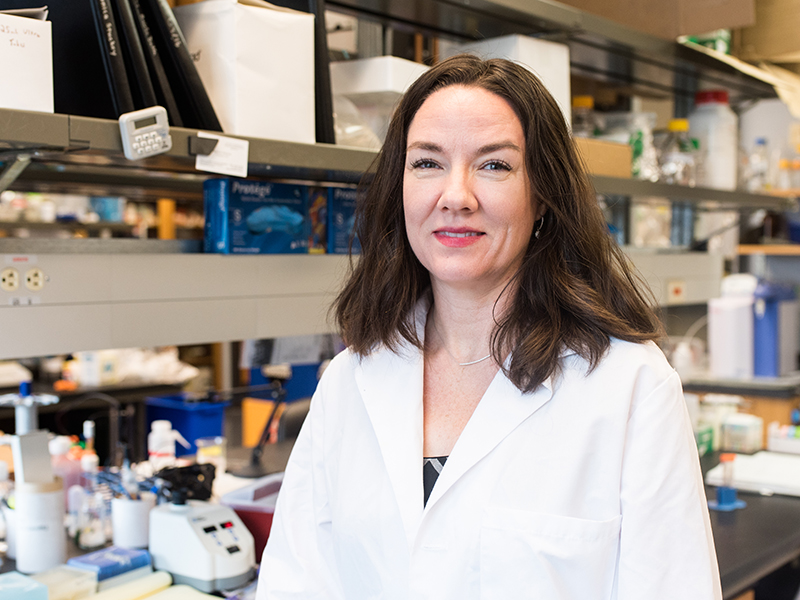
Laura Suggs, a professor in the Department of Biomedical Engineering at The University of Texas at Austin, has received five new grants from the National Science Foundation, the National Institutes of Health and Texas Biologics. The funding will support projects within two overarching research efforts: creating a better home for growing stem cells and designing tiny particles that can help calm the body’s immune system when it overreacts.
“Every material that is in contact with a cell is a message. Whether we are building a matrix to culture cells or a nanoparticle that modulates the immune response, our success depends on understanding how the cell interprets what it touches,” said Suggs.
A Better Home for Stem Cells
Stem cells are special cells that can become many different types of cells in the body, which makes them valuable for studying disease and developing new regenerative medicine treatments. Keeping them healthy and capable of becoming any cell type is a major challenge, and they are delicate and difficult to grow in the lab.
In collaboration with Texas BME colleague Professor Janet Zoldan, Suggs is developing a soft, gel-like material to give these cells a place to live and grow. The gel is built from three basic ingredients of life: peptides, nucleic acids and polysaccharides. When mixed in water, these molecules assemble on their own into a web of tiny fibers. Cells can be placed inside the gel as it forms, where it supports their growth and helps them keep their ability to become different cell types.
Two grants support this work:
- Tuning Nucleopeptide Matrices for Stem Cell Culture (National Science Foundation): The team will study how the gel forms and how the structure of its tiny fibers affects stem cell growth and flexibility.
- Nucleopeptide Scaffolds for Cell Culture and Transfection (National Institutes of Health): The team will explore using the gel to deliver small genetic molecules called miRNAs, which help regulate cell behavior, to keep stem cells healthy as they grow.
Teaching the Immune System to Stand Down
The immune system can sometimes react too strongly when protecting us from infection. In food allergies, it can attack harmless proteins. After a blockage in a blood vessel is reopened, it can cause painful inflammation that slows healing.
Working with Professor Zhengrong Cui in the College of Pharmacy at The University of Texas at Austin, Suggs is developing tiny particles that leverage a natural process to induce tolerance and limit inflammation. When cells in our bodies die, immune cells such as macrophages quietly clear them away without causing inflammation. The research team designs particles that mimic dying cells, so immune cells take them up and respond by calming the body down rather than sounding the alarm.
Three grants support this work:
- Mechanobiology of Innate Immune Cell Responses to Engineered Nanoparticles (National Science Foundation): This project, which is in collaboration with Professor Vernita Gordon from the Department of Physics at UT Austin, examines how a particle’s properties and the surfaces and surroundings on which immune cells sit influence whether and how those cells take up the particle, and how they respond afterward.
- Modulating Inflammatory Macrophages with an Apoptotic-Inspired Nanoparticle (National Institutes of Health): The team aims to develop an injectable nanoparticle that delivers anti-inflammatory molecules directly to immune cells.
- An Allergen Delivery System for Immunotherapy of Food Allergy (TX Biologics): The team, including Professor Robert O. Williams III from the College of Pharmacy at UT Austin, is adding peanut allergens to the particles to train the immune system to tolerate peanuts rather than attack them.
Suggs looks forward to continuing her ongoing collaborations across the Forty Acres. “I’ve worked alongside each of them for more than a decade, and they are among the very best at what they do. Over those years, we’ve built a shared language across very different disciplines, and that lets us take on problems none of us could solve alone.”