Peppas and Anslyn Receive NIH Funding to Improve Early Detection of Autoimmune Disorders
Professors Nicholas Peppas and Eric Anslyn have received a $1.3 million NIH grant to investigate using nanotechnology to noninvasively diagnose Sjögren’s syndrome.
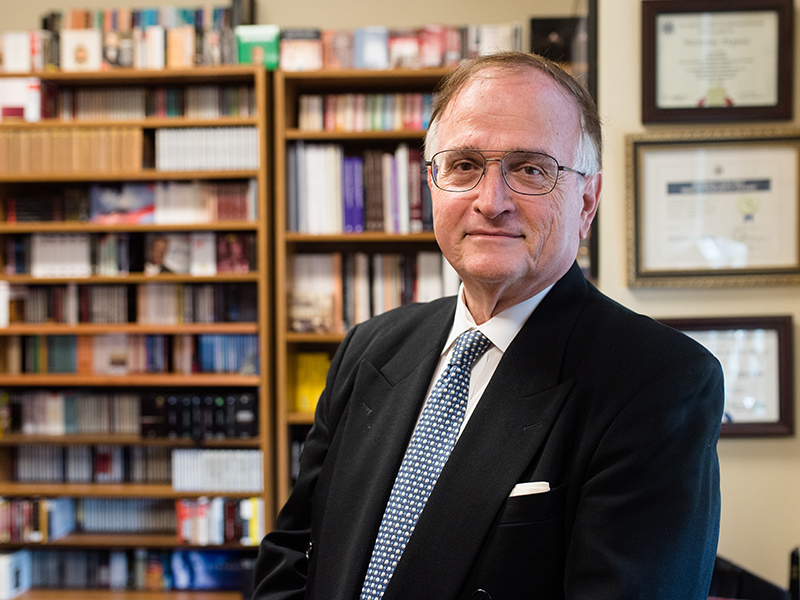
Nicholas Peppas, professor in the Department of Biomedical Engineering and the Department of Chemical Engineering at the Cockrell School of Engineering
Treatment of autoimmune disorders is most effective when they are diagnosed early. In Sjögren’s syndrome, an autoimmune disease that affects the exocrine system, patients suffer from dry eye and dry mouth. Diagnosis is often delayed by six to ten years, even after symptoms appear. Currently, patients must undergo multiple tests, including a biopsy of the salivary gland, to diagnose Sjögren’s syndrome.
Nicholas Peppas, professor of biomedical engineering, chemical engineering, and pharmacy, and Eric Anslyn, professor of chemistry, have received a $1.3 million NIH grant to investigate how to use nanotechnology to noninvasively diagnose Sjögren’s syndrome in the early stages of the disease. In their approach, a diagnostic sensor array is used to monitor protein concentration changes in the saliva or tears of symptomatic patients. An earlier diagnosis can help mitigate damage that occurs later in the disease. Patients with Sjögren’s syndrome may have difficulty speaking, swallowing, or seeing, and, in later stages, more serious complications, such as complete vision loss and development of non-Hodgkin lymphoma.
Overall, the goal of the research is to provide a more robust, low-cost, noninvasive diagnostic tool that measures biochemical changes in a patient and could provide earlier diagnosis for Sjögren’s syndrome and potentially other autoimmune disorders.