You Had to Be There
The first class of biomedical engineering grads threw a dance party in 2004. More than 20 years later, they are leaders in their field and still disagree over who won.
The year is 2004. The Spirit and Opportunity rovers landed on Mars. The Red Sox were on the way to winning their first World Series in 86 years. Facebook and Gmail were just becoming a thing.
In the dimly lit basement of Taos Co-Op just off The Drag, 16 engineers battled it out on the dance floor in a post-semester party for the ages as dozens more watched on. David Cho did a backflip according to one source. Another attests the winner cemented the victory by bowing over a towel they had folded over their hand, butler-style.
“You know, like they were being served? Like, you know, how a butler serves you? So the towel made them the butler…”
But when this reporter spoke to the first class of biomedical engineers from The University of Texas at Austin (2006), she found that there was disagreement over who, ultimately, deserves the title of Champion of Dance. Some swore that Steven Chen won. Others were adamant that it was David Cho, with his legendary handspring (backflip? No, definitely a handspring). It became clear that real investigative work would be required to discover the truth.
We interviewed six of the first class of BME undergraduates to discover where their careers had taken them (and who really won a dance-off 20 years ago):
David Cho, The Exploration Company
Thinks David Cho Won.
Cho worked as a NASA contractor for 17 years before moving into the private sector. He began as a payload safety engineer. The work involved assessing the safety of human physiological experiments taking place on the shuttles and space station, a strong fit for someone trained as an engineer with experience in the mechanics of human health. He now works in the private sector for The Exploration Company, which works to commercialize space flight.
Cho counts the academic heft and quality of people he got to experience the first days of the program with as key features of the inaugural class.
“It was just a bunch of amazing people that we had in our class,” Cho said. “I was very fortunate to be a part of that.”
But let it be known: When it came to sick moves, David Cho was king. “When you talk to Kunal, tell him I said hi, and definitely talk to him about the dance-off.”
Dr. Kunal Shah, cardiac electrophysiologist at Ascension Texas Cardiovascular
Thinks Steven Chen Won.
When Shah was picking a major in the drop-down menu, biomedical engineering just sounded cool.
If you had asked him during this time, he would have told you there was no way he was going to be a doctor. He wasn’t excited to take care of knee pain or sore throats. He didn’t like the doctor’s office. And yet, here we are.
After graduating from UT, Shah attended Baylor College of Medicine and completed a residency at Loyola University Medical Center. He credits his BME classmates for helping him through medical school. Many had already gone through the process and could give him pointers on fellowships and studying for the MCAT.
“These are still some of my closest friends to this day. Having a safety net of people you feel safe with, that you can be yourself with in college is sort of everything.”
Dr. Hilda Kriel, associate professor of Pediatric Orthopedics at Tulane University
Thinks Steven Chen Won.
Immediately after undergrad, Kriel took a year off to travel before attending medical school. She thought she would resist becoming a surgeon, but, “Joke’s on me,” she absolutely fell in love with surgery during her rotation at University of Texas Medical Branch. She then completed a pediatric orthopedic fellowship at Baylor College of Medicine and went on to work in Temple, Texas, as the division director of pediatric orthopedics, before leaving for Tulane.
“Being BME’s first class, we really had to take control of our own education.”
The novel nature of their class prepared Kriel for a career in orthopedic surgery.
“You see things that like, three other people in the world have seen, and you just have to figure the treatment out.”
Kriel did not participate in the dance-off, but believes Steven Chen won. “Cho is a liar. I will text him right now.”
Dr. Sanket Borgaonkar, interventional cardiologist at Houston Methodist
Thinks David Cho Won.
Borgaonkar went on to get his master’s degree in biomedical engineering at UT in 2008, and then to Texas A&M’ School of Medicine and Baylor College of Medicine in Houston for residency and fellowship, where he’s remained in private practice.
Biomedical engineering is about learning how to solve problems and think analytically, which are crucial skills as a physician and certainly as a cardiologist, Borgaonkar says. His favorite class in undergrad was the senior design project, which certainly applied problem-solving, but also allowed for more camaraderie. This is a group project where students engineer and design product prototypes based on biomedical engineering problems and usually involves a lot of late hours.
He is a bit hazy on who won the dance-off the first year. The winner was determined via crowd response, which is hardly scientific.
“We’d have a conversation on the WhatsApp about it. I’m pretty sure it was David that won. But I don’t know, now I have my doubts.”
Dr. Irvin Sulapas, Sports Medicine Physician
Thinks David Cho Won.
Sulapas is someone who has always prized relationships. For a brief time after medical school at Ross University and then in his medical rotation at Texas Tech School of Medicine in Lubbock, he wanted to be one of the old-fashioned rural country doctors helping to take care of the old folks and deliver babies. But during his family medicine residency, he met two sports medicine fellows that worked as team doctors on the sidelines of football games. This was a new avenue he hadn’t considered before.
After completing his sports medicine fellowship, he got a job at Baylor College of Medicine as faculty, and also served as a team doctor for the Houston Dynamo and Houston SaberCats for a number of years before leaving for his current position at Houston Methodist and serving a private school. He is also the team doctor for USA Rugby, and toured with the women’s national team in Wales and Scotland this past September.
One thing that Sulapas carried with him from undergrad into medical school was the endurance to study. He remembers that other students hadn’t ever sat down to study all day before. Sulapas just shrugs – six hours of studying was light work for a BME grad.
But it was at one of the study marathons late one night his class got to thinking about their dance party as a real competition – with brackets and everything. A real dance-off. This is how he remembers who the real victor was.
I lost to David Cho in the finals, so it was definitely David Cho who won.
Irvin Sulapas
“Steven Chen… he won in our hearts.”
Malisha Pattanaik, regional sales director at Boston Scientific CRM-Dx
Thinks Steven Chen Won.
Pattanaik earned her Master of Science in Bioengineering from the University of California San Diego, where she worked on cancer cell separation using pH control and dielectrophoresis. She moved to California to experience life outside of Texas, but after completing her master’s degree, she knew she wanted to return home.
Pattanaik learned about an opportunity to become a “clinical specialist,” at Boston Scientific, a medical expert that follows a patient’s health journey after they’ve received a device in surgery and provides technical expertise during procedures. The role felt like a natural fit after experiencing early stage research and development through a co-op while in California and her undergraduate education at UT.
She’s now spent 16 years with the company, taking on multiple roles and continuing to grow within the organization.
Of that night in 2004, Pattanaik recalls drawing a “I love mom” tattoo on her arm and losing to Steven Chen in the semifinals.
“But whoever Carmen says won, probably she’s right.”
Carmen Rios, senior project manager at the Broad Institute of MIT and Harvard
Knows David Cho Won.
How the heck can anyone be confused by who won the first year? It was Cho.
Carmen Rios
Rios knew she didn’t want to pursue medical school after graduating and instead joined MD Anderson Cancer Center. While working there, she obtained her MBA from the University of Houston, and attended the University of Pittsburgh to get a master’s degree in bioengineering. She went on to work as a researcher at Boston Children’s Hospital before joining the Broad Institute of MIT and Harvard. It was at the Broad that she discovered her true enthusiasm and talent for project management. Today, she is a part of a team that conducts cancer cell research within the Broad’s Cancer Program.
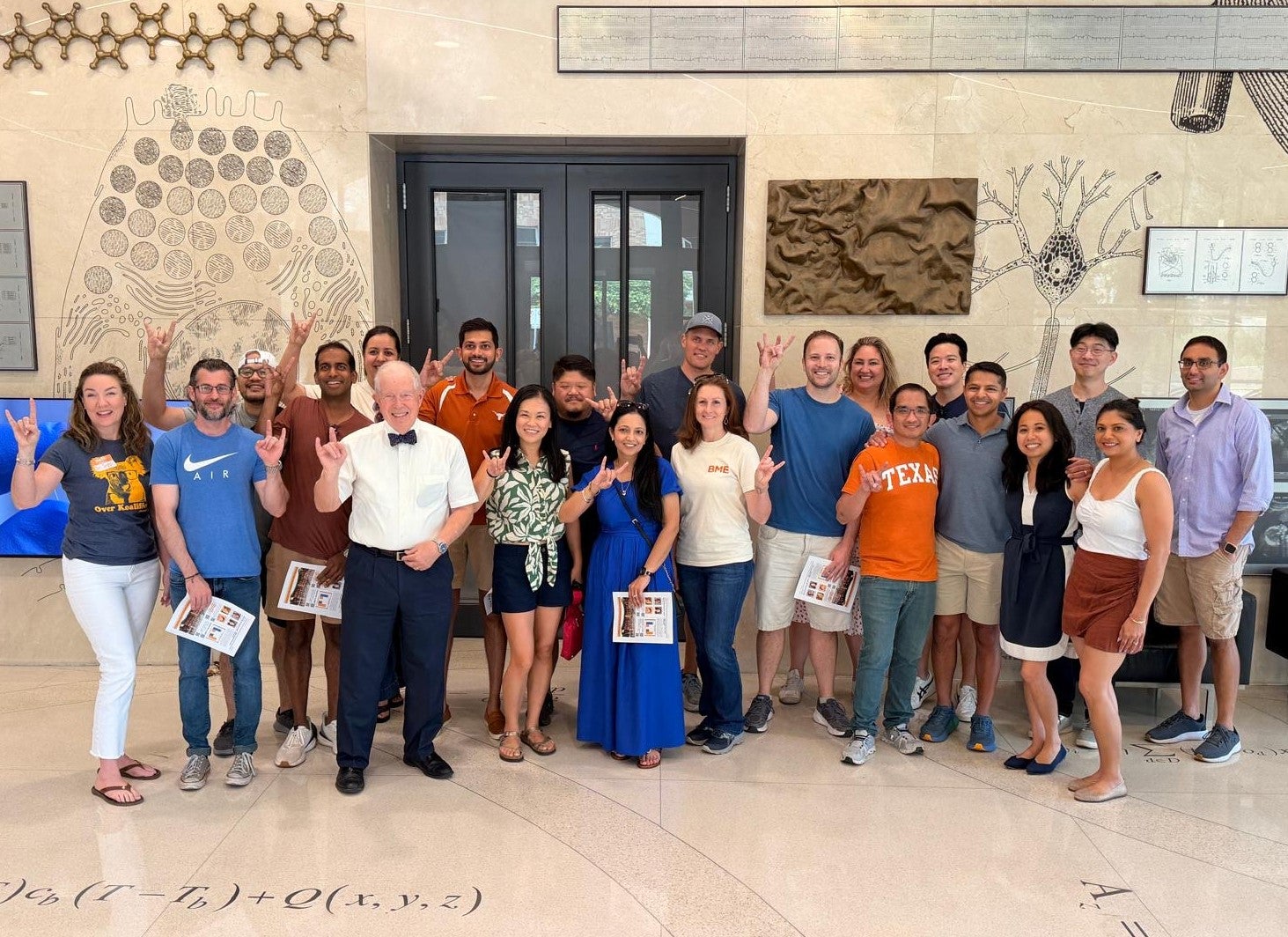
Confirmation of Cho’s evident victory—Rios is generally credited with a better memory than most we contacted, and Sulapas was certain he made it to the final round—has been lost to time. The ‘06 class agreed this was likely for the best. Newer, less incriminating pictures have replaced the old ones from reunions, weddings and other get-togethers.
We were guinea pigs in a lot of ways for professor Ken Diller and the faculty. And I think we’re sort-of proud of it.
Carmen Rios
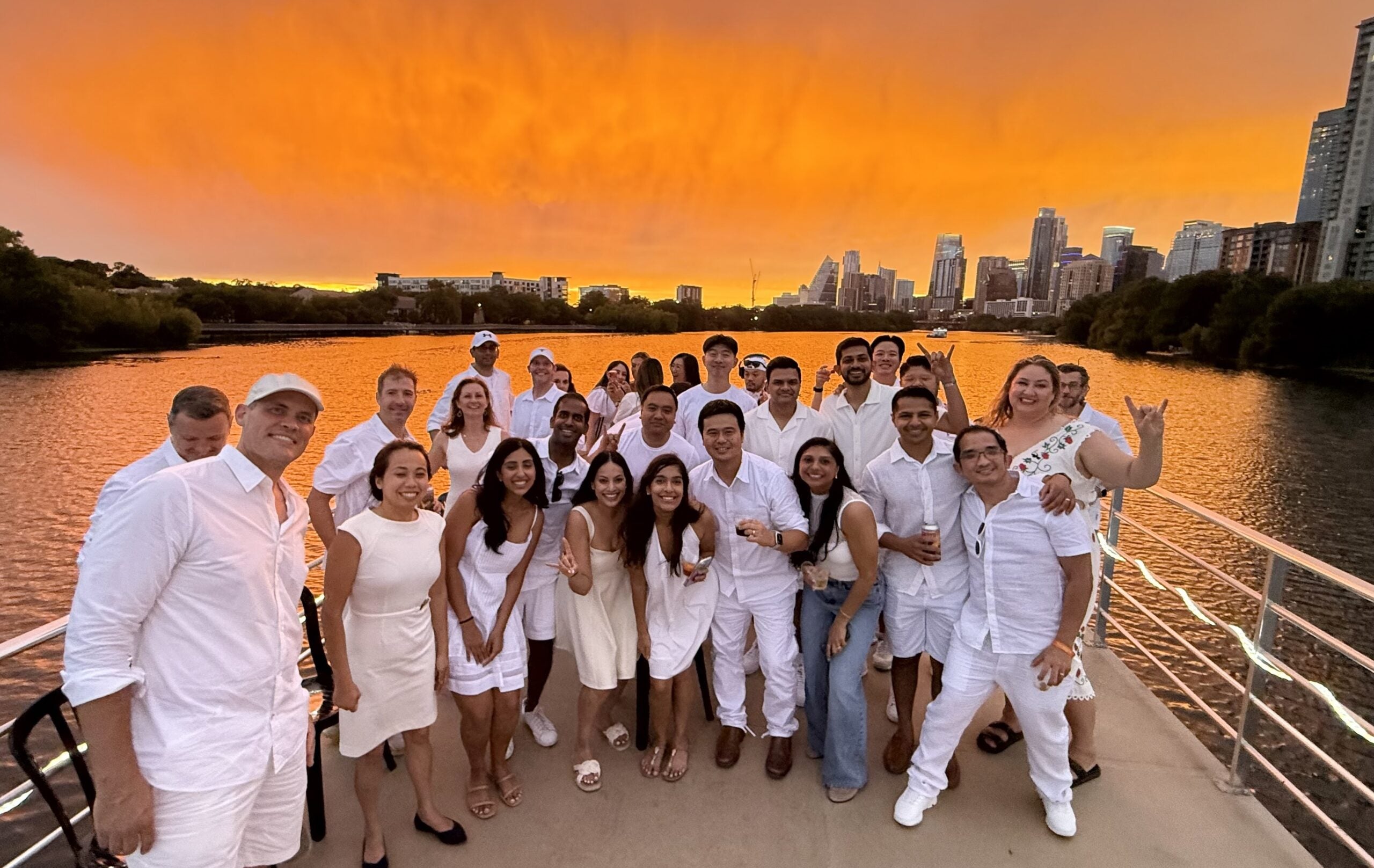
Their advice for current BME students is simple: Stay close to the friends you make here. These times are the trenches where you prove your mettle, and the people with you in those trenches can help you succeed, not just here, now, but in the future. They can be a support network to guide you through the MCAT; a lead on a job; a couch to sleep on in a strange city; sworn enemies in the battle for dance supremacy; a hell of a party; a family.
More Stories
Texas Engineering Once Again Named Among Top 10 Best Graduate Engineering Programs